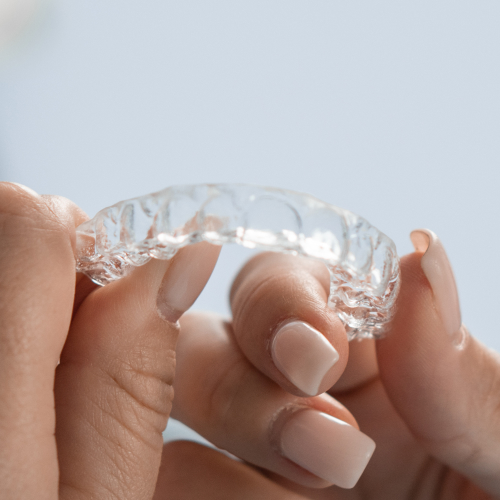
Spark vs. Invisalign vs. Ceramic Braces: What Houston Patients Need to Know
Comparing Spark vs. Invisalign vs. ceramic braces in Houston? Discover costs, benefits, and which orthodontic treatment is best for your smile. Book today!
Read More
Medically Reviewed by Dr. Ali Tameemi
Invisalign works well for mild to moderate crowding and many bite corrections, but severe cases hit real biomechanical limits. Whether it can fix your specific problem depends on whether your bite issue is dental or skeletal — and how much space your crowding actually requires. For patients in Houston exploring all their options, aesthetic dentistry offers a broader look at how alignment, appearance, and function can be addressed together.
This is the distinction most patients never hear until they're already in the chair. When someone asks "Can Invisalign fix my severe overbite?", the answer hinges almost entirely on one question: is the problem in your teeth, or in your jaw bones themselves?
A dental overbite means your upper front teeth angle forward too aggressively, but your jaw bones are appropriately sized relative to each other. Clear aligners can tip and torque teeth into better positions, and Invisalign handles dental overbites reasonably well.
A skeletal overbite is different. Here, the upper jaw (maxilla) or lower jaw (mandible) is physically disproportionate — one is too far forward or too far back. No amount of tipping teeth will fix a jaw that is structurally mispositioned. According to Healthline, traditional braces are still considered the standard of care for correcting severe overbites, and skeletal discrepancies often require intervention beyond aligners alone.
How do you tell the difference? A few clinical clues: look at your profile in a mirror. If your chin appears noticeably recessed or your lower face seems short relative to your upper face, skeletal factors are likely involved. Your orthodontist will confirm this with a cephalometric X-ray measuring the ANB angle — the angular relationship between the upper and lower jaw.
For growing patients, Invisalign's mandibular advancement "wings" can actually encourage jaw repositioning while teeth are still developing. For fully formed adult jaws with severe skeletal discrepancy, the standard workflow is surgical orthodontics: Invisalign or braces align the teeth first, a surgeon physically repositions the jaw bone (orthognathic surgery), and then final tooth alignment is completed. Invisalign plays a real role in this process — just not the lead role.
Crowding is measured in millimeters of arch-length deficiency — how much space your teeth need versus how much your arch actually provides. Mild crowding (1–3 mm) is straightforward. Severe crowding (7 mm or more) is where Invisalign's limits become concrete.
To create space without extracting healthy teeth, providers use interproximal reduction (IPR): carefully shaving microscopic amounts of enamel from the contact points between teeth. The safety math matters here. A dentist can safely remove approximately 0.2 mm to 0.5 mm of enamel per contact point. Across six anterior contact points, that yields roughly 2–3 mm of total space.
Run the numbers forward: if your crowding requires 6 mm or more of space, IPR alone cannot safely deliver it. At that threshold, premolar extractions become the realistic path — creating 7–8 mm of usable space per side. In some cases, a tooth extraction is the necessary first step before orthodontic treatment can proceed effectively. Research published in PMC confirms that while crowding resolution with clear aligners is achievable through proclination, arch expansion, and IPR, body movements in extraction cases remain less predictable with aligners than with fixed appliances.
Arch expansion is another tool. A systematic review on arch expansion in PMC found that aligners can effectively widen the dental arch, though expansion accuracy decreases from the canine region toward the molars. The takeaway: expansion helps mild-to-moderate crowding but cannot compensate for the space demands of severe cases.
Here is where complex bite correction gets genuinely difficult. Correcting a deep bite requires intruding (pushing up) the front teeth or extruding (pulling down) the posterior teeth — both vertical movements. Open bite correction demands the opposite mechanics. And vertical forces are where plastic aligners are structurally weakest.
The physics: a clear aligner wraps around the crown of a tooth. It applies force efficiently in the horizontal plane. But when the system tries to intrude a tooth upward into the bone, the plastic tends to peel away from the tooth surface rather than transmit the force cleanly. When this happens, the aligner stops "tracking" — it no longer fits precisely — and tooth movement stalls.
WebMD notes that adults with more complex dental histories may experience longer treatment timelines, partly because achieving precise movements in fully formed bone is less predictable. Research supports this concern: a study reviewed on PubMed found that clear aligner treatment achieved only about 33% of planned overbite correction on average, with maxillary central incisors showing the lowest accuracy.
The clinical workarounds are real and effective when applied correctly:
When tracking does fail, a mid-course refinement is required: new intraoral scans, revised ClinCheck planning, and a fresh set of trays. This is normal in complex cases — not a failure — but patients benefit from knowing it is likely before treatment begins. Patients who also have underlying issues like gum disease or gingivitis should have those conditions treated before or during orthodontic care, as gum health directly affects how teeth respond to movement.
Despite its limits, Invisalign has expanded considerably since its original indication of mild crowding. A clinical effectiveness review in PMC documents that the system can perform meaningful tooth movements including significant bicuspid derotation and root movements of upper central incisors — capabilities that did not exist in early aligner versions.
For mild-to-moderate Class II malocclusions with a dental (not skeletal) component, for open bite cases with careful attachment planning, and for crowding cases where IPR or strategic expansion can create sufficient space, Invisalign delivers outcomes comparable to traditional braces. Patient compliance — wearing aligners 20 to 22 hours per day — remains the single most controllable variable in whether complex treatment succeeds or stalls.
The honest answer is that severity and type matter more than the brand of aligner. A comprehensive exam, cephalometric imaging, and an experienced provider who is transparent about what your specific case demands will tell you far more than any general comparison of aligners versus braces. Maintaining regular cleaning and exam appointments throughout treatment is equally important, as professional cleanings help prevent decay and gum issues that can complicate or delay orthodontic progress.
Complex crowding and bite issues deserve a thorough evaluation — not a one-size-fits-all answer. At Nu Dentistry Tanglewood, our team serves patients throughout Houston, including the Tanglewood and Uptown communities, with comprehensive orthodontic consultations that assess your specific jaw structure, crowding severity, and bite type before recommending a path forward. If teeth are significantly damaged or decayed alongside alignment concerns, options like dental implants may also be part of a complete treatment plan. Reach out to schedule your evaluation and get a clear picture of what treatment can realistically achieve for you.
Medical disclaimer: This article is intended for informational purposes only and does not constitute medical or dental advice. Always consult a licensed dental professional for diagnosis and personalized treatment recommendations.
Fresh news from the dental world

SEE WHAT A VISIT TO OUR MODERN, STATE-OF-THE-ART DENTIST OFFICE IS LIKE!


Monday - Friday 9am - 6pm
Saturday 9am - 3pm
Sunday Closed
Check out what our patients are saying in Houston, TX


“Never Thought I'd Say It”
I never thought I’d say it, but going to the dentist is actually fun now. I recently came in for a root canal, and I got to sit back and catch up on Stranger Things without any pain!

“Anxiety Has Kept Me Away ”
I usually have such huge anxiety when I go to a dentist appointment, which means I always put off visits until the last minute to disastrous consequences. However, Dr. Loggins helped me with sedation, so the entire process was a breeze!

“The Best Dentist In Houston”
We have been looking for a family dentist for a long time. Not too long ago we met Dr. Ali. Not only was he professional, kind, and gentle, but he always finds a way to fit us in when we need an appointment. He’s also pretty funny! I appreciate that he takes the time to explain what he’s doing, before he does it. That really puts me at ease.

“Part Of The Family”
When I come in for an exam, Dr. Alrajab makes me feel like I’m a part of his family. I haven’t had a single cavity or filling done since I started coming here, which is a real change from my last hygienist.
“Never Thought I'd Say It”
I never thought I’d say it, but going to the dentist is actually fun now. I recently came in for a root canal, and I got to sit back and catch up on Stranger Things without any pain!
“Anxiety Has Kept Me Away ”
I usually have such huge anxiety when I go to a dentist appointment, which means I always put off visits until the last minute to disastrous consequences. However, Dr. Loggins helped me with sedation, so the entire process was a breeze!
We are proud members of these dental organizations and accreditations


Check us out and follow our Houston, TX practice on social media...


