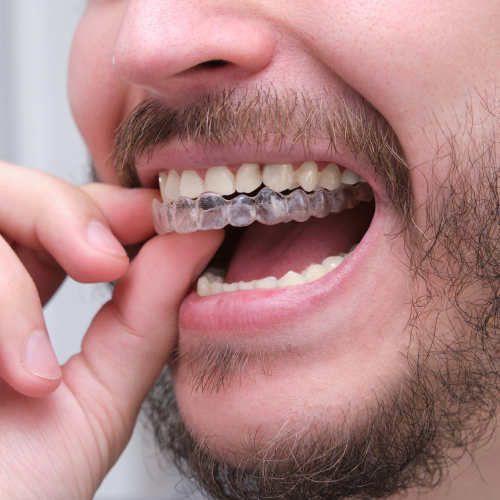
How Does Invisalign Compare to At Home Aligners Like Byte and SmileDirectClub?
Wondering if Byte or SmileDirectClub is as good as Invisalign? Compare at-home aligners with in-office care. Schedule your consultation at Nu Dentistry today!
Read More
Reviewed by Dr. Ali Tameemi, DDS
Whether a dental implant lasts ten years or twenty-five comes down to factors most patient guides skip — bone foundation quality, surgical planning protocol, material selection, and the questions you ask before surgery. Houston patients who understand these variables walk into their consultation with the right framework instead of a generic checklist.
Most patients assume implant placement is a single procedure. For straightforward cases that's true — but for many, the jaw needs preparation before an implant can integrate properly. Understanding when and why is the first step toward realistic expectations.
According to Healthline, titanium implants depend on osseointegration — the biological fusion of bone tissue with the implant surface. That fusion only happens if there's enough healthy bone in the right location. When density has declined, two preparatory procedures come into play.
Bone grafting restores the volume needed for an implant to anchor securely. Synthetic (allograft) grafting is less invasive; autogenous grafting harvests bone from another site on the patient's body and is reserved for larger defects. The longer a tooth has been missing, the more likely a graft is needed — bone resorption begins almost immediately after extraction and continues progressively.
Sinus lifts apply specifically to upper back teeth, where the sinus cavity sits near the jawbone. An internal (crestal) lift suits modest deficits; a lateral window approach is reserved for cases with very thin residual bone.
A practical rule of thumb: if a tooth has been missing for more than twelve months, plan for a bone graft consultation as part of the workup. If multiple upper back teeth have been gone for years, assume a sinus lift may be on the table until imaging confirms otherwise. If you're exploring dental implants as a tooth replacement option, this is the diagnostic conversation that should happen before any surgical date is set.
For patients comparing implants to bridges or dentures, the long-term picture is where implants distinguish themselves.
Research published in PMC found implant-supported single crowns delivered better long-term outcomes than fixed dental prostheses across a ten-year horizon, largely because bridges require periodic replacement and can compromise the adjacent abutment teeth they rely on.
A Healthline comparison places the ten-year implant survival rate near 97%, while bridges typically need replacement every five to ten years. That replacement cycle is the part most patients don't factor in when weighing options.
Mayo Clinic also notes a structural advantage: because implants fuse with the jawbone through osseointegration, they don't trigger the bone loss that follows a missing tooth or a poorly fitting denture. Preserving that bone protects facial structure and reduces the likelihood of needing more invasive interventions later.
Implant failure is uncommon — roughly two to five percent of cases — but worth asking direct questions about before surgery:
A surgeon who answers these directly is one I'd trust with my own care.
Patients sometimes notice that two surgeons describe what sounds like "the same procedure" very differently. The variation isn't random — it reflects clinical decisions about materials, hardware, and planning protocol.
Implant material. Titanium remains the standard because of its osseointegration profile and decades of clinical track record. Ceramic (zirconia) appeals to patients with metal sensitivities or thin gum tissue where dark metal could show through, but it's more brittle and the long-term data is thinner. Healthline's overview of titanium implants walks through the tradeoffs.
Crown type. A tooth crown made from porcelain-fused-to-metal performs differently than an all-ceramic crown. For front teeth, all-ceramic typically wins on aesthetics; for molars taking heavy bite force, PFM often holds up better.
Number of implants. Replacing several adjacent teeth with an implant-supported bridge — two implants supporting three crowns, for example — is more efficient both clinically and structurally than placing a separate implant for each missing tooth.
Surgical planning technology. Practices using 3D CBCT imaging and digital surgical guides invest in higher upfront tooling, but they tend to deliver more precise placement, fewer revisions, and lower complication rates over time.
Cleveland Clinic notes the entire implant process can span six to twelve months — extraction (if needed), graft healing, implant placement, integration period, abutment, and final crown. That isn't a delay to work around; it's the biological reality of letting bone fuse around hardware before loading it with bite force.
For Houston patients in the Tanglewood and Uptown areas, a typical sequence looks like:
Patients who try to rush this timeline are the ones most likely to encounter complications. Patients who respect it are the ones who get the twenty-year outcomes.
The honest answer about what a specific case requires comes from imaging and an examination — not a phone estimate. At Nu Dentistry Tanglewood, patients receive a detailed clinical evaluation and an itemized treatment plan before any procedure begins. Dental sedation options are available throughout the implant process for patients who prefer them.
If you're in the Tanglewood or Uptown Houston area and ready to start that conversation, reach out to schedule a consultation.
This content is for informational purposes only and does not constitute medical or dental advice. Individual treatment needs vary. Please consult a licensed dental professional for a personalized evaluation.
Fresh news from the dental world

SEE WHAT A VISIT TO OUR MODERN, STATE-OF-THE-ART DENTIST OFFICE IS LIKE!


Monday - Friday 9am - 6pm
Saturday 9am - 3pm
Sunday Closed
Check out what our patients are saying in Houston, TX


“Never Thought I'd Say It”
I never thought I’d say it, but going to the dentist is actually fun now. I recently came in for a root canal, and I got to sit back and catch up on Stranger Things without any pain!

“Anxiety Has Kept Me Away ”
I usually have such huge anxiety when I go to a dentist appointment, which means I always put off visits until the last minute to disastrous consequences. However, Dr. Loggins helped me with sedation, so the entire process was a breeze!

“The Best Dentist In Houston”
We have been looking for a family dentist for a long time. Not too long ago we met Dr. Ali. Not only was he professional, kind, and gentle, but he always finds a way to fit us in when we need an appointment. He’s also pretty funny! I appreciate that he takes the time to explain what he’s doing, before he does it. That really puts me at ease.

“Part Of The Family”
When I come in for an exam, Dr. Alrajab makes me feel like I’m a part of his family. I haven’t had a single cavity or filling done since I started coming here, which is a real change from my last hygienist.
“Never Thought I'd Say It”
I never thought I’d say it, but going to the dentist is actually fun now. I recently came in for a root canal, and I got to sit back and catch up on Stranger Things without any pain!
“Anxiety Has Kept Me Away ”
I usually have such huge anxiety when I go to a dentist appointment, which means I always put off visits until the last minute to disastrous consequences. However, Dr. Loggins helped me with sedation, so the entire process was a breeze!
We are proud members of these dental organizations and accreditations


Check us out and follow our Houston, TX practice on social media...


