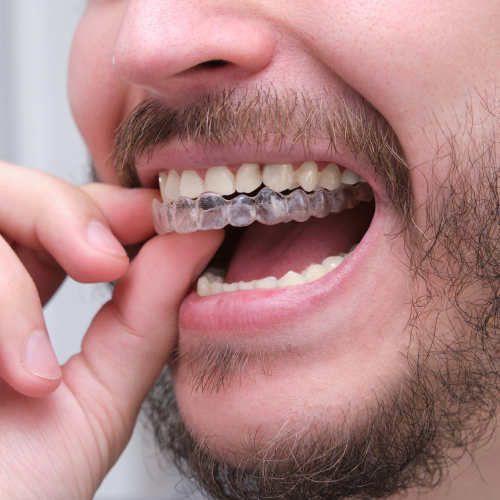
How Does Invisalign Compare to At Home Aligners Like Byte and SmileDirectClub?
Wondering if Byte or SmileDirectClub is as good as Invisalign? Compare at-home aligners with in-office care. Schedule your consultation at Nu Dentistry today!
Read More
Reviewed by Dr. Ali Tameemi, DDS
Gum disease doesn't just threaten your teeth — it actively destroys the bone that supports your face, and waiting too long forecloses options you'll wish you still had. The good news: periodontitis is manageable, and "manageable" is a far better outcome than most people fear when they first hear the diagnosis.
Most people think about gum disease in terms of teeth — loose teeth, lost teeth, gaps in the smile. What rarely gets discussed is what happens to the jaw itself when alveolar bone disappears.
For Houston-area patients, the alveolar bone does two jobs simultaneously. It anchors the teeth, and it provides the skeletal scaffolding that holds facial soft tissue in place. The vertical height between the nose and chin, the fullness of the lips, the definition of the jawline — all of it depends on that underlying bone volume. When periodontitis progressively resorbs that bone, the soft tissue above it has nowhere to go but inward and downward.
The result is what clinicians describe as "facial collapse" — the sunken, aged appearance that most people associate with advanced age or long-term denture wear. Marionette lines deepen. The lips thin and turn inward. The lower third of the face shortens visually. This is not a cosmetic footnote. It is a structural consequence of untreated bone loss, and it happens gradually enough that many patients don't connect the change in their appearance to what's happening beneath the gumline.
According to Mayo Clinic, periodontitis destroys the bone that supports the teeth — and that destruction is irreversible once it progresses past a certain threshold. The bone doesn't grow back on its own. What is lost, is lost.
This is why Houston patients are urged to take early warning signs seriously: bleeding gums, persistent bad breath, gum recession. These are not cosmetic inconveniences. They are early signals that a process is underway that will eventually reshape the face if left unchecked. Staying current with cleaning and exam appointments is one of the most effective ways to catch these signals before they become irreversible.
A common assumption among patients is: "If it gets bad enough, I'll just get implants." That assumption is genuinely dangerous, because it misunderstands what implants require.
A dental implant is a titanium post that anchors into the jawbone. For that anchor to hold, there needs to be adequate bone volume — typically at least 10mm of height and 6mm of width in the implant site. When periodontitis has been destroying alveolar bone for years, those dimensions shrink. At some point, there simply isn't enough bone left to place an implant without first rebuilding what was lost.
That rebuilding — bone grafting, sinus lifts — adds thousands of dollars and months of healing time to treatment that would have been straightforward earlier. And in severe cases, even grafting can't restore enough volume to support implants reliably. At that stage, traditional removable dentures become the primary option, which carries its own cascade of problems including continued bone resorption underneath the denture base.
Cleveland Clinic notes that gum disease is the leading cause of tooth loss in adults — and the bone destruction it causes is what makes reconstruction so complicated afterward. Waiting is not a neutral choice. It is a choice that narrows future options and inflates the cost of restoring what has been lost.
Yes — and understanding why helps clarify what treatment actually accomplishes.
NIH research has shown that an unhealthy oral bacterial population triggers specialized immune cells (Th17 cells) that drive the inflammation responsible for bone destruction. The bacteria aren't destroying bone directly — the immune system's response to them is. This is why periodontitis behaves more like a chronic inflammatory disease than a simple infection that can be cleared with a course of antibiotics.
There's also a bidirectional relationship worth knowing about. Research published in PMC confirms that periodontitis and systemic bone conditions like osteoporosis share overlapping mechanisms — specifically, an imbalance between osteoclasts (bone-destroying cells) and osteoblasts (bone-building cells) that tips toward net bone loss. Patients with osteoporosis may find their alveolar bone more vulnerable. In cases of severe periodontitis, systemic bone markers may reflect it as well.
The bone that periodontitis destroys does not naturally regenerate. But — and this matters enormously — the disease itself can be brought into remission.
Think of it less like a broken bone that heals and more like Type 2 diabetes. It can be managed, controlled, and lived with well. Patients who commit to proper periodontal care commonly experience a shift from active destruction to stability. The pockets don't deepen further. The bone loss stops progressing. That's not a cure, but it's a genuinely good outcome.
The practical reality of remission means a different maintenance schedule. Instead of a standard 6-month cleaning, patients with periodontitis typically move to 3-month periodontal maintenance appointments. That frequency isn't punishment — it's what the research shows is necessary to keep bacterial populations below the threshold that triggers renewed inflammation. The American Academy of Periodontology recommends annual comprehensive periodontal evaluations and consistent maintenance as the cornerstone of long-term management.
No. But the hygiene schedule has changed permanently, and that's worth accepting clearly.
Patients who do best are the ones who stop searching for a way to "reverse" periodontitis and start building the habits that keep it quiet. Scaling and root planing to remove bacterial deposits below the gumline. Three-month maintenance visits without exception. Consistent home care. Addressing systemic factors — blood sugar control, smoking cessation — that accelerate disease progression.
Understanding the full scope of gum disease is essential to recognizing how early intervention changes long-term outcomes. The American Academy of Periodontology is clear that periodontal disease is linked to cardiovascular disease, diabetes, and Alzheimer's disease — which means managing it isn't just about the mouth. It's about reducing systemic inflammatory burden across the board.
A periodontitis diagnosis is not a sentence. It is a diagnosis that responds well to treatment when caught before the bone loss becomes severe enough to close off available options. Patients who treat it early keep their teeth, maintain their facial structure, and remain implant-eligible if they ever need that path. Those who wait lose choices one by one.
If you've been told you have gum disease — or you've noticed bleeding gums, recession, or shifting teeth — the time to act is before the bone loss makes your decisions for you. Nu Dentistry Tanglewood serves patients across the Greater Houston area, including Tanglewood and Uptown, with accurate assessment of periodontal health and long-term management plans that protect both oral and overall health. Schedule a dental emergency evaluation or a comprehensive periodontal assessment and find out exactly where you stand.
This article is intended for general informational purposes only and does not constitute professional dental or medical advice. For diagnosis and treatment recommendations specific to your situation, please consult a licensed dental professional.
Fresh news from the dental world

SEE WHAT A VISIT TO OUR MODERN, STATE-OF-THE-ART DENTIST OFFICE IS LIKE!


Monday - Friday 9am - 6pm
Saturday 9am - 3pm
Sunday Closed
Check out what our patients are saying in Houston, TX


“Never Thought I'd Say It”
I never thought I’d say it, but going to the dentist is actually fun now. I recently came in for a root canal, and I got to sit back and catch up on Stranger Things without any pain!

“Anxiety Has Kept Me Away ”
I usually have such huge anxiety when I go to a dentist appointment, which means I always put off visits until the last minute to disastrous consequences. However, Dr. Loggins helped me with sedation, so the entire process was a breeze!

“The Best Dentist In Houston”
We have been looking for a family dentist for a long time. Not too long ago we met Dr. Ali. Not only was he professional, kind, and gentle, but he always finds a way to fit us in when we need an appointment. He’s also pretty funny! I appreciate that he takes the time to explain what he’s doing, before he does it. That really puts me at ease.

“Part Of The Family”
When I come in for an exam, Dr. Alrajab makes me feel like I’m a part of his family. I haven’t had a single cavity or filling done since I started coming here, which is a real change from my last hygienist.
“Never Thought I'd Say It”
I never thought I’d say it, but going to the dentist is actually fun now. I recently came in for a root canal, and I got to sit back and catch up on Stranger Things without any pain!
“Anxiety Has Kept Me Away ”
I usually have such huge anxiety when I go to a dentist appointment, which means I always put off visits until the last minute to disastrous consequences. However, Dr. Loggins helped me with sedation, so the entire process was a breeze!
We are proud members of these dental organizations and accreditations


Check us out and follow our Houston, TX practice on social media...


